


16.09.2025. Two new studies from the Food and Agriculture Organization of the United Nations (FAO) make a powerful case that wood products are a major climate solution — while warning that their potential remains too often ignored or undervalued.

Drawing on regional data from Asia-Pacific and global projections through 2070, the researchers show that replacing steel and concrete with timber, extending the lifespan of wood products, scaling up recycling and reuse, and optimising production processes could massively cut greenhouse gas emissions — in some scenarios by as much as 50% compared with conventional construction.
These benefits, however, only materialise if the wood comes from sustainably managed forests where carbon stocks are maintained.
The first study, Wood Products for Climate Change Mitigation in the Asia-Pacific Region, highlights a region that is home to more than half of the world’s population and is projected to account for two-thirds of new urban floor space by 2050. Targeted policy reforms and market incentives could elevate timber’s role in decarbonising buildings and infrastructure from marginal to truly transformative.
The second, Forest Product Demand and Supply in a Bioeconomy Transition, co-authored with Bauhaus Earth and a network of international partners, projects global supply and demand for engineered wood through 2070. Its findings suggest that shifting a significant share of construction to engineered timber alone could deliver nearly half of the sector’s total emissions reduction potential — while accelerating the transition to a sustainable bioeconomy.

A crucial point must be stressed:
Structurally intact forests in Central Africa, particularly in the Congo Basin, continue today to absorb more carbon than they release. A study shows that between 1985 and 2015 their storage capacity remained stable at around 0.66 tonnes of carbon per hectare, projected to continue until 2040, compared to only 0.24 tonnes of carbon per hectare in the Amazon, projected to decline to 0 by 2040 (Hubeau et al., 2020, Nature 579, 80–87).
By contrast, the Amazon, degraded by fires and deforestation, is gradually becoming a net source of carbon (Gatti et al., Nature, 2021). And in South-East Asia, the destruction of natural forests in favour of oil palm plantations has led to massive emissions, notably through the drainage of tropical peatlands. Projections suggest that this destruction could account for 51% of all future peatland emissions through 2130 (Wijedasa et al., Global Change Biology, 2018).
The global forest carbon sink absorbs nearly half of fossil fuel emissions (7.8 ± 0.4 Pg, or 7,800 Mt per year between 1990 and 2019). Yet two-thirds of this benefit are offset by tropical deforestation. To safeguard this sink, land management policies are needed to curb deforestation, restore forests, and improve timber harvesting through sustainable, certified forestry (Pan et al. 2024, Nature 631(8021):563-569).
Specifiers, architects, importers — are you ready to lead this shift?
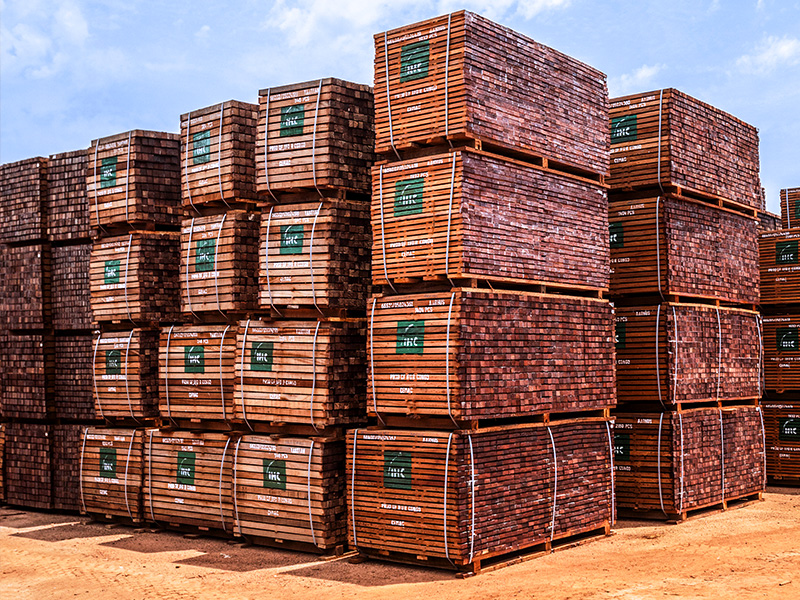
Photos © Interholco
About Interholco
The valorisation of a natural forest of 1.16 million hectares in the Republic of Congo Brazzaville is our DNA here at INTERHOLCO. As an FSC® (Forest Stewardship Council®, FSC® C022952) and PEFC and PAFC certified producer, INTERHOLCO is a well-established player in the trade of its edged boules, sawn timber, glue laminated scantlings, decking boards and more.
We are a leading provider of high-quality wood products ‘Made in Africa’ holding a verified environmental and health performance statement (FDES requirement in France). Our teams carefully manage the supply chain from forest to customer. Our story is fully illustrated by enabling the people living in Ngombe to access better life conditions. We make it possible to design and build a healthy living environment with bio-based, eco-friendly materials, one of the real solutions for the planet and climate. Follow us on LinkedIn
Communication contact Interholco
Tullia Baldassarri Höger von Högersthal
INTERHOLCO AG, Neuhofstr. 25, 6340 Baar, Switzerland
Tel.: +41 (0)41 767 03 82
E-mail: This email address is being protected from spambots. You need JavaScript enabled to view it.